

Born one hundred years ago this month, beloved actor Harry Dean Stanton (died 2017) gets the star treatment with The Brattle Theatre’s “The Stanton Rule: A Harry Dean Stanton Centennial.” The event, running from July 12-19, showcases 13 of the actor’s most iconic films, giving the viewers an opportunity to appreciate a dying breed of performer, the character actor.
What is a character actor, anyway? In our modern parlance, the term can often be used derisively to describe any performer who is, let’s say, unconventionally attractive.

Beyond looks, the difference between a character actor and a leading actor is right there in the descriptor: character. Where a star gets their name above the title, bringing their own cultivated public persona to every role, a character actor is a chameleon, placing the character above all else, disappearing into the performance and consequently making the film’s world feel real and lived-in, populated with the kinds of people anybody in the audience would be familiar with.
Sometimes these supporting performers are forgettable, and sometimes they’re Harry Dean Stanton.
Among his featured films are the two major exceptions to a career spent mostly in supporting roles: Wim Wenders’ 1984 masterpiece, “Paris, Texas” (July 19) and Stanton’s cinematic swan song “Lucky” (July 16).
In these noteworthy starring roles, Stanton brings an egoless sensitivity that imbues their respective stories with everyday profundity: “Paris, Texas” as a heart-breaking, beautiful exploration of memory, loss and love in down-and-out America and “Lucky” as a personal reckoning with mortality and the search for meaning in even the most humble of lives. “Lucky” offers Stanton the kind of farewell performance rarely afforded anyone but the most in-demand actors, itself a testament to the transcendent powers of Harry Dean Stanton.
These starring roles were a rarity for Stanton, who spent most of his career lending his quiet gravitas and blue-collar authenticity to ensembles in beloved classics, including the anti-establishment “Cool Hand Luke,” the cinematic punk rock of “Repo Man,” and the spiritual reckoning of “The Last Temptation of Christ.” Stanton contributes texture and dignity in each film, able to communicate so much even when his dialogue is sparse.
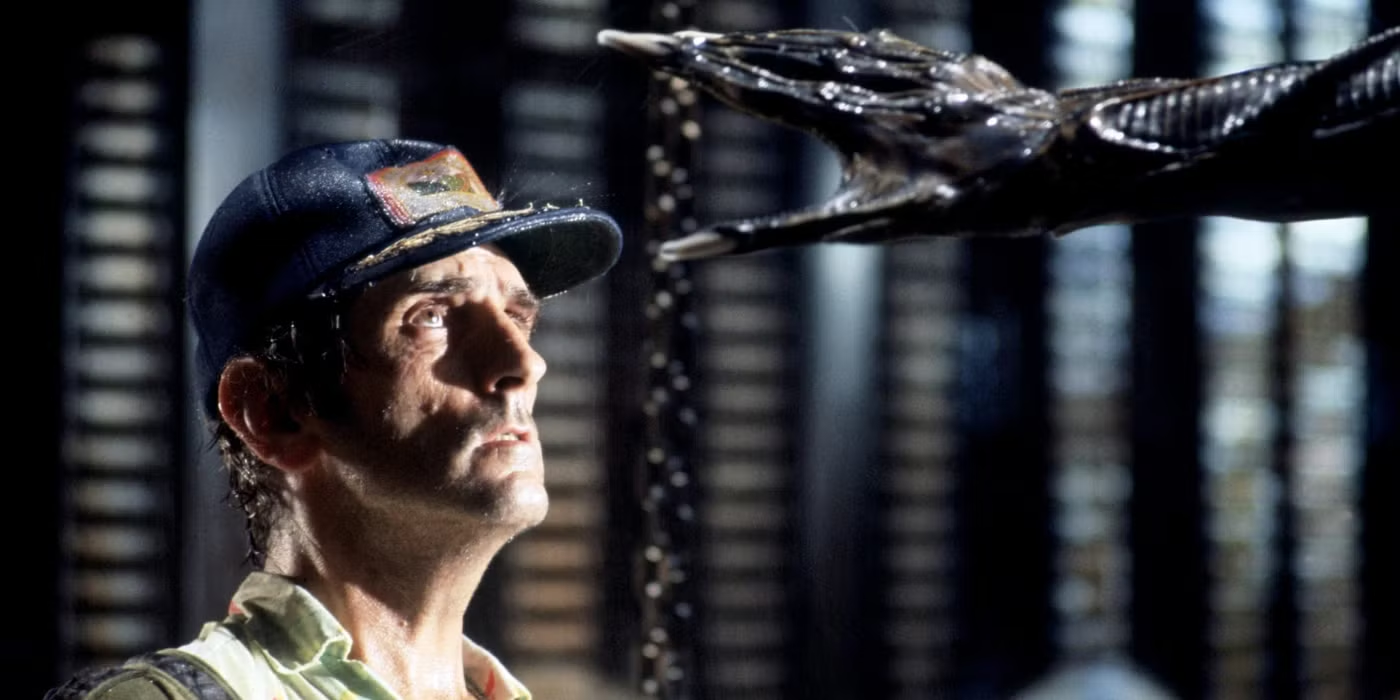
Consider Ridley Scott’s “Alien” (screening July 18) as another prime example. Much of the horror derives from the isolation, yes, but what makes it so visceral is that the victims are not some vapid ne’er-do-wells, unfamiliar with struggle. These are the rugged working class, with the Hawaiian shirt-clad Stanton, a man who has never encountered something that could shake him. When he conveys fear, we feel it more because he’s not supposed to be scared, proving that a well-placed character actor can heighten the most primal emotions.
Sadly, in the ever-changing economic landscape of Hollywood, we are losing our character actors.
In the midst of The Brattle’s “Stanton Centennial,” the movie event of the summer will be released: Christopher Nolan’s “The Odyssey.” Much has been made of the casting for this highly-anticipated blockbuster, with every minor role filled with a bankable name, somebody who would otherwise be headlining their own movies are here playing even the smallest of roles.
I don’t intend to pick specifically on “The Odyssey,” as the use of A-list stars in supporting roles is not a new phenomenon. Historically, though, it was reserved for only the biggest of event films and now seems to be found in most major studio releases. What was once exceptional has instead become commonplace, with the acting hierarchy flattening such that A-list stars are infiltrating every level of filmmaking. At any given moment, you can find Nicole Kidman in a Hollywood blockbuster, the prestige TV series du jour, and an AMC commercial letting you know that, somehow, heartbreak feels good in a place like this.
The unfortunate side effect of this A-list proliferation is diminishing opportunities for working class actors, making them fight for an ever-dwindling number of roles and leaving audiences with stars whose star power feels less impactful through overexposure. Maybe that’s why film feels less and less essential as the years go by, relinquishing its place as the dominant art form.
Part of the problem is the Marvel-ization of so much cinema, filling a cast with a megastar in the hopes that you can then spin them off into their own movie. Chasing box office profitability by attaching big names to small roles, Hollywood risks cheapening their stars and the movies themselves. When every role is filled with a glamorous, attractive face, the narrative risks crumbling under the weight of so many stars. How can an audience be expected to stay immersed in a story when, at every turn, the first thought is “Oh wow, Charlize Theron’s in this?”
Stars feeling more empowered to seek out projects that inspire them rather than confining themselves to lead roles is commendable. Yet by filling every role with A-Listers we risk losing out on an important aspect of cinema’s power: relatability. Where the stars, with their impossibly good looks and charisma are aspirational, the supporting players allow everyday viewers to see themselves on the screen. Without that relatability, cinema risks becoming as inauthentic as social media, filled with a homogeneous, unattainable beauty standard that pushes out other faces, other bodies, other Harry Dean Stantons.

Even as Hollywood seems ready to render the character actor a relic of a bygone era, with this retrospective, The Brattle is doing its part to preserve the legacy of one of cinema’s absolute best.
To experience or re-experience just how profound an impact a classic supporting player can have on a work of art, I implore you to go to one of the many repertory screenings scheduled at The Brattle. All of the films mentioned above will be screened, as will a pair of John Carpenter collaborations (“Christine”, “Escape from New York”) and the Brat Pack classic “Pretty in Pink.”
The films span the decades, crossing all genres, with Harry Dean Stanton’s indelible performances the only constant. Throughout his sixty year career, through over one hundred feature films, Stanton flourished in roles no matter what they demanded of him. While he has his share of big emotions throughout this slate of films, Stanton truly sets himself apart in the small moments: a glance, a sigh, a phone call. Because for Harry Dean Stanton, in roles big and small, he never seemed like he was acting.
He was living.
Curt Ege also writes on movies at Curt On The Movies.
